
Blog
Diode Basics: Rectifier, Zener, Schottky and LED Explained

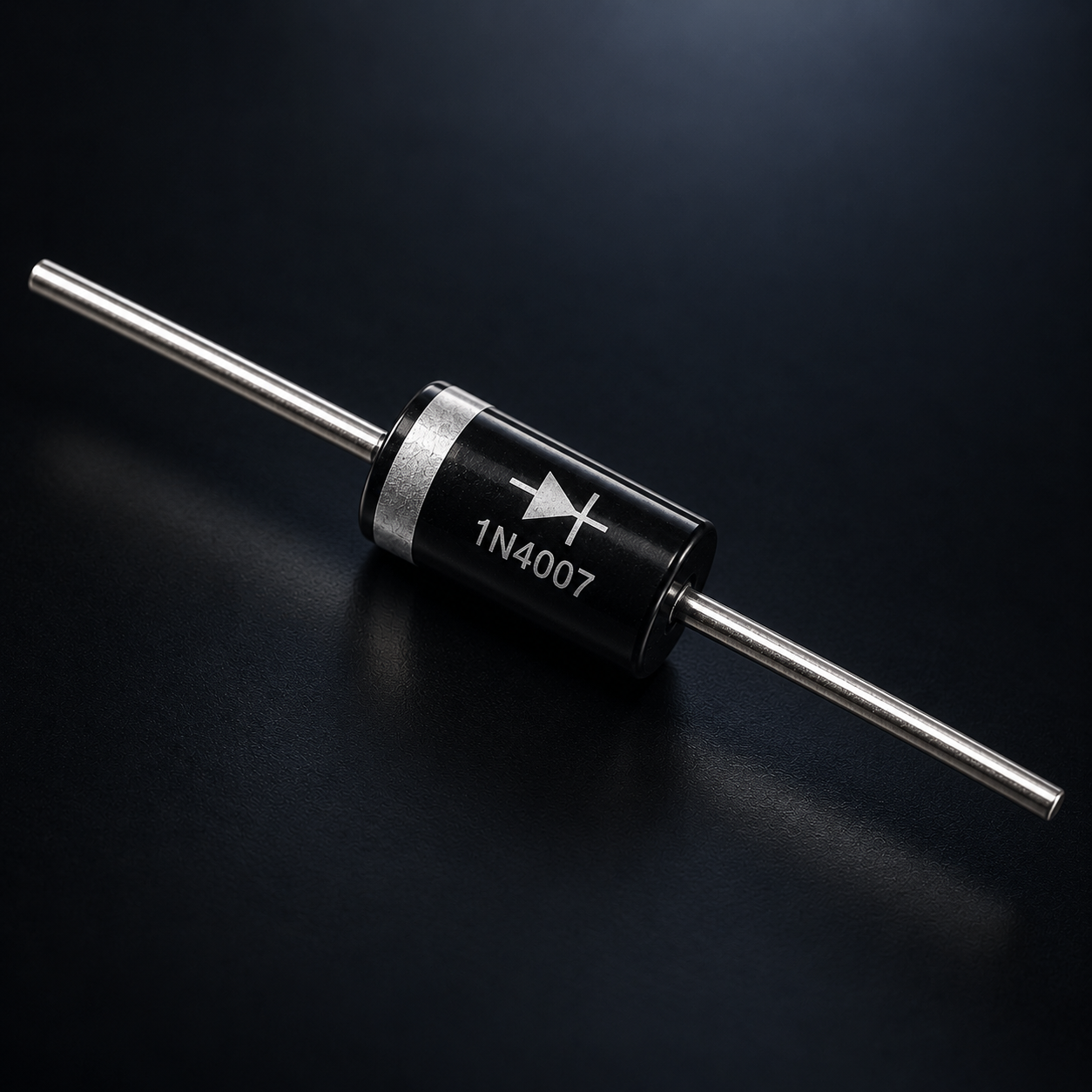
Diodes look simple, but each family is built for a different job. Here is a quick guide to the ones you will use most.
Rectifier diodes (e.g. 1N4007)
Rated 1 A and 1000 V, with a forward drop of roughly 0.7–1 V. Use them for AC-to-DC conversion, reverse-polarity protection and flyback protection on relays.
Small-signal diodes (e.g. 1N4148)
Fast-switching and low-current — ideal for logic circuits, signal clamping and protecting microcontroller pins.
Schottky diodes (e.g. 1N5819)
A much lower forward drop (typically 0.2–0.45 V) and fast recovery, so they waste less power in battery circuits and switching regulators. The trade-off is higher reverse leakage.
Zener diodes (e.g. 1N4733A, 5.1 V)
Designed to conduct in reverse at a set voltage — useful for simple voltage references and over-voltage clamps. Always use a series resistor.
LEDs
Red LEDs typically drop around 1.8–2.2 V; blue and white around 3 V. Size the series resistor with R = (Vsupply − VLED) / I. For a red LED at 10 mA from 5 V: (5 − 2) / 0.01 = 300 Ω, so use the nearest standard value, 330 Ω.
Rule of thumb
The stripe on the body marks the cathode, and conventional current flows from anode to cathode.
